Studio Monitors vs Headphones: What You Should Really Mix On
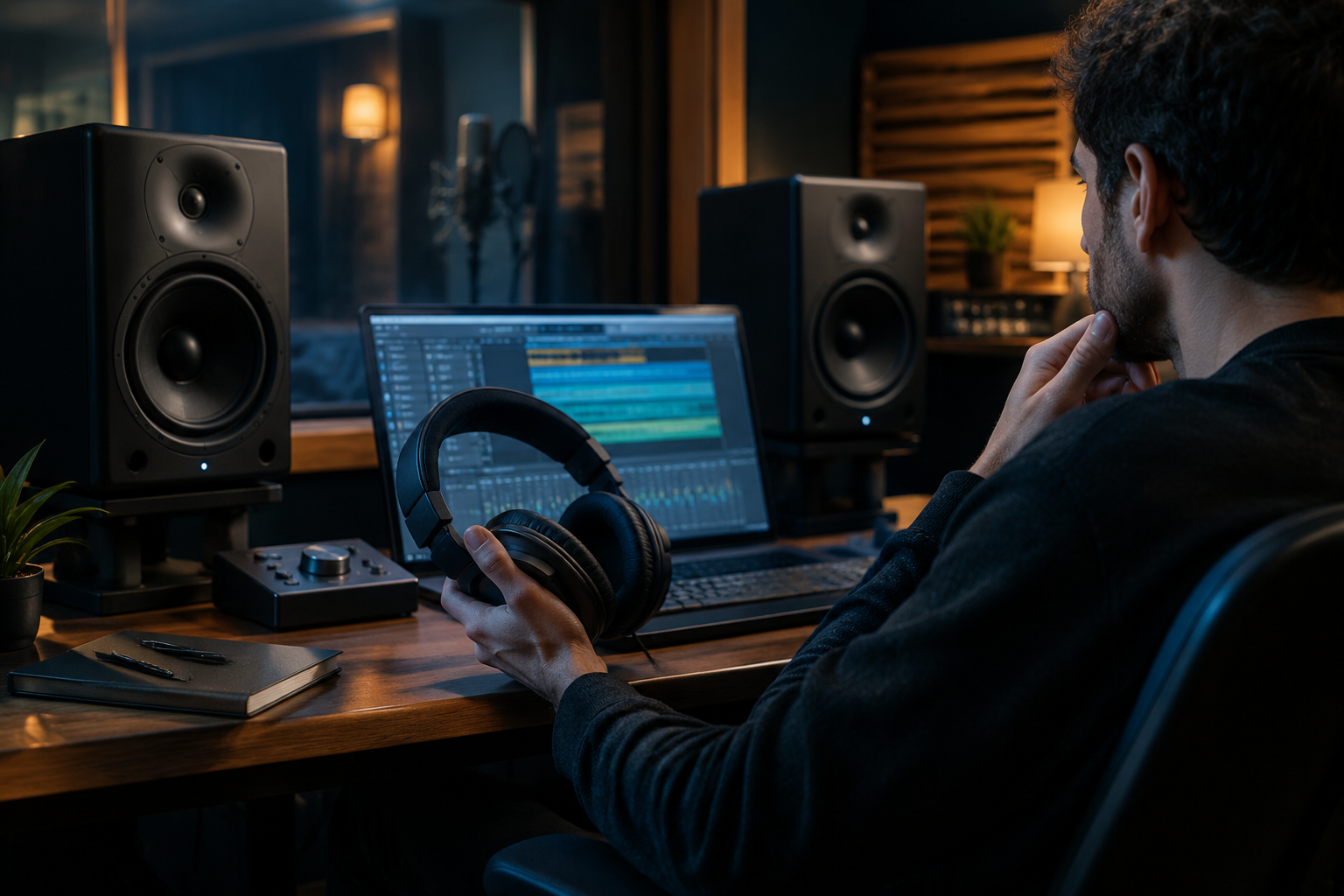
Every few months someone posts a clip of their mix and asks why it falls apart in the car. The answer is almost never the plugins. It’s that they mixed the whole thing on one pair of headphones in a room they never actually heard. Monitors and headphones do different jobs, and pretending one replaces the other is the fastest way to a mix that only works in one place.
Here’s how I actually split the work between them, and where each one lies to you.
What each one is actually good at
Studio monitors and a treated room give you something headphones fundamentally can’t: a physical sense of how sound moves through space. You hear the low end in your chest, not just in your ears. You hear phase relationships between the kick and the bass as they interact in the air. The stereo image sits in front of you, and you can walk around and confirm it holds up.
Headphones give you detail. They expose clicks, breaths, fret noise, and reverb tails that a room smears together. They also remove the room from the equation entirely, which matters enormously if your room is untreated. A pair of decent closed-back headphones in an untreated bedroom is more honest about the midrange than cheap monitors bouncing off bare walls.
Neither is the “real” answer. Both are tools, and the trick is knowing which problems each one can and can’t show you.
Where headphones lie to you
The biggest problem with headphones is the low end. Because the drivers sit right on your ears, you feel sub frequencies that don’t actually exist at that level in a room. You mix the bass to feel right on your head, then play it on a system with real air movement and it’s either bloated or thin. This is the classic “sounds fine in headphones and wrong in the car” scenario, and it’s a translation problem before it’s ever a level problem.
There’s a related trap: the kick and the 808 occupying the same fundamental. On headphones the phase relationship between them changes with how you move your head, and one playback system will hide the collision while another exposes it. You can’t EQ your way out of two sounds fighting for the same space if you never heard them fight.
Stereo is the other lie. On headphones, hard-panned elements feel wide and dramatic. On speakers in a room, they can collapse into one side or feel disconnected. Mix decisions about width made entirely on headphones tend to be overcooked.
Where monitors lie to you
Your room. Always your room. A monitor is only as good as the space it’s in. Put a pair of Yamaha HS7s ($320) in a bare bedroom with a window on one side and a wall two feet behind you, and you’re hearing the room more than the speaker. Bass builds up in corners. Early reflections smear the midrange. You’ll make EQ moves to fix problems that only exist in your specific geometry.
That’s not an argument against monitors. It’s an argument for treating the room before you spend more on gear, or at least for learning your room’s specific faults so you can compensate. Bass traps in the corners and a thick rug do more for mix translation than a monitor upgrade.
The practical split I use
I do the bulk of balancing on monitors, at a moderate volume, in a room I’ve spent time learning. That’s where I set levels, make broad EQ decisions, and judge the low end. Then I switch to headphones for the detail pass: checking vocal intelligibility, hunting resonances, catching noise.
- Monitors for: level balance, low-end weight, stereo image, how the mix feels as a whole.
- Headphones for: detail, resonance, clicks, reverb tails, midrange clarity.
- Both, plus a phone speaker and a car, for: the final translation check.
One cheap pair of monitors won’t tell you everything, and one expensive pair won’t fix an untreated room. The point is to hear the mix through more than one lens before you commit.
Reference tracks do the heavy lifting
The fastest way to calibrate either setup is to mix against a reference. Pick a track that sounds the way you want yours to sound, and A/B constantly. Not to copy it, but to reset your ears. Your room or your headphones will push you toward certain decisions, and a reference pulls you back to reality.
One reference isn’t always enough. I’ll often use two or three: one for the bass and drums, another for the vocal character. That way I’m not trying to make one song do something it was never arranged to do. The reference has to actually resemble the sound you’re chasing, or you’ll waste hours tuning your ear to the wrong target.
What no monitoring setup will fix
This is the part people skip. A better monitoring chain won’t save a mix where the real problem lives in the arrangement. If the vocal disappears in the chorus, that’s not a monitoring issue and it’s not an EQ curve you can dial in on the master. It usually means the guitar doubling that arrives in the chorus buried it. The fix is a musical decision about which element loses, not a measurement.
An automated tool will happily turn up the whole 2 to 4 kHz band, make the cymbals harsh, and only slightly clarify the vocal. That’s because a machine sees a spectrum, not a song. The vocal is the reason the track exists, and no algorithm knows that. You do, and you only hear it clearly if your monitoring chain lets you hear the relationship between parts.
Similarly, if something feels off and you can’t name it, the answer isn’t a new plugin. It’s usually that the second verse has the same energy as the first, so the drop stops landing. That’s an arrangement problem you diagnose by listening to the whole song through good monitoring, not by staring at a spectrum analyzer.
So what should you actually mix on?
If you have to choose one and your room is untreated, good headphones plus a reliable reference will get you further than cheap monitors fighting bad acoustics. Honest midrange beats fake low end every time.
If you can do both, do both. Learn your room’s faults, treat what you can afford to treat, and use headphones as a second opinion rather than the final word. The goal isn’t to pick a side. The goal is to hear your mix the way other people will, and that means checking it through as many honest lenses as you can before you call it done.