Serum vs Vital: Which Wavetable Synth Should You Learn First?
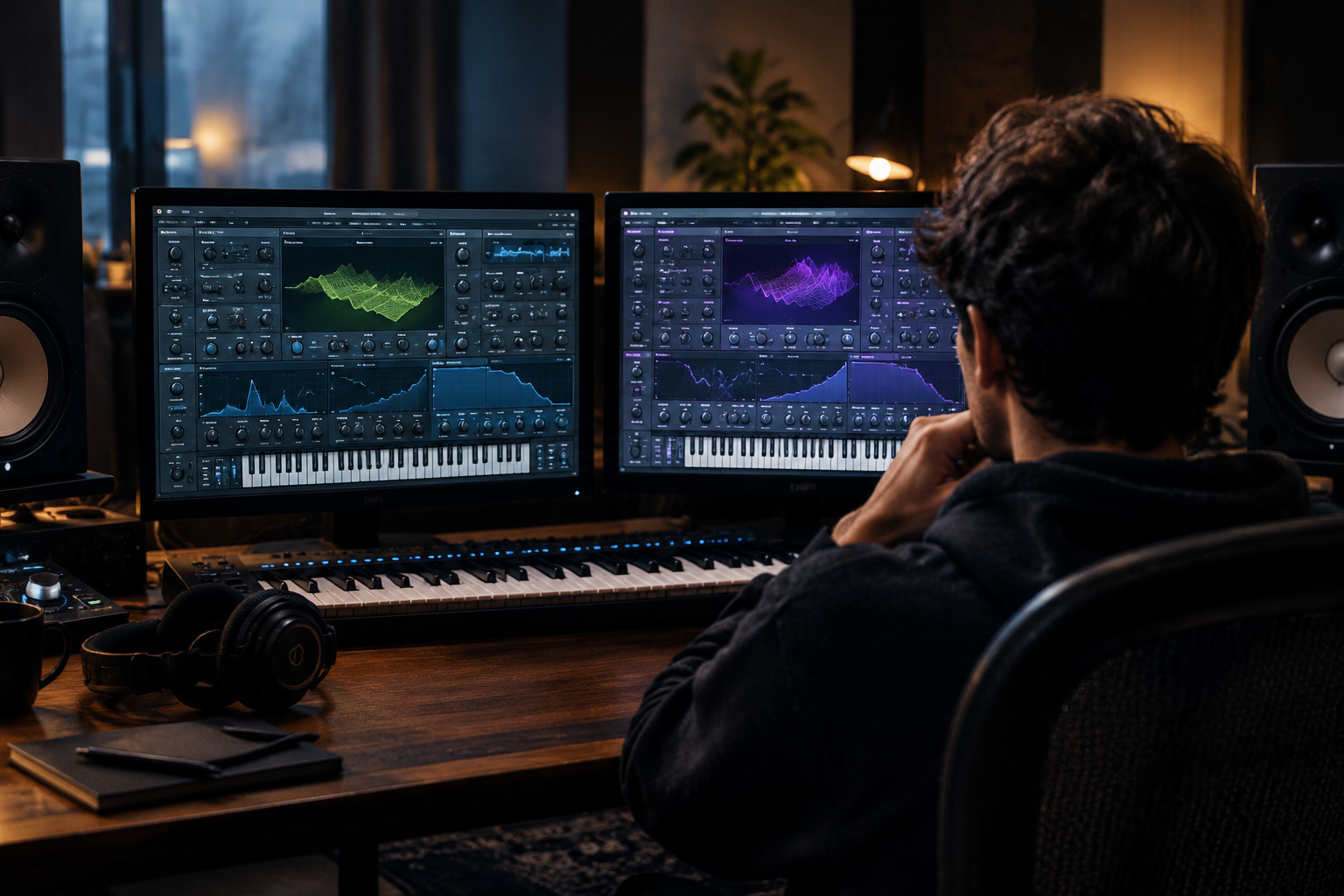
Every few months someone asks me the same question in a Discord server: should I learn Serum or Vital first? It’s a fair thing to agonize over when you’re just starting out. Both are wavetable synths. Both are visual, drag-and-drop friendly, and capable of sounds you’d struggle to get out of a stock instrument. But they aren’t the same tool, and the one you learn first shapes how you think about synthesis for a couple of years.
I’ve put serious hours into both. Here’s my honest read.
The short answer, before the nuance
If you have the money and no strong feelings, learn Serum. It’s the synth most tutorials are made for, and that matters more than any spec sheet when you’re learning. If money is tight, or you’re on Linux, learn Vital. It’s a complete instrument for free and you will not outgrow it.
That decision comes down to one real factor: what you want to learn from. The rest is interface differences, and both interfaces are good.
What Serum actually gives you
Serum is built by Xfer Records and has sat near the top of wavetable synthesis for years, and there’s a reason for that longevity. The workflow is the thing. You drag an LFO onto a parameter and it just works. You see the waveform animate. You see the filter respond. For someone learning synthesis, that visual feedback is the difference between understanding modulation and memorizing where the knobs are.
The engine itself is an oscillator setup worth knowing: two wavetable oscillators, a flexible noise generator, and a sub-oscillator that’s deliberately dirty in a good way. You get over 75 filter types and 10 effect rack units to chain after the sound. There’s a mod matrix with four macros, three envelopes, and four LFOs. On top of that, Serum ships with over 400 patches that are genuinely usable starting points rather than filler.
None of those numbers is why I recommend it. The mod matrix and the drag-and-drop modulation are. Once you’ve routed an envelope to wavetable position and heard the sound change in front of you, synthesis stops being abstract. That’s the fastest route from “I don’t get it” to “I know why that sounds like that.”
Where Serum annoys me
It’s not cheap, and the full price is a real commitment if you’re not sure you’ll stick with this. Serum does offer a rent-to-own plan through Splice at 0% interest, and you can freeze payments when money is tight, which softens the blow. Still, you’re paying for something Vital gives you for nothing.
It also isn’t an analog-sounding synth out of the box. That’s not the point of it. If you want instant warmth, you’re reaching for filter choices and effects, not a single knob.
What Vital gets right, and where it stumbles
Vital is a spectral warping wavetable synth by Matt Tytel, and it’s the best free synthesizer I’ve used. That’s not a polite compliment. It’s a full synthesis engine that matches the feature sets of the most popular commercial synths, and the free version is a complete instrument rather than a demo.
The interface is the standout. Even with a complex engine underneath, Vital stays intuitive. You open it and you can find things. It’s well laid out, and for beginners that matters more than any oscillator mode.
The trade-offs are real, though. The free version caps you at three custom wavetable slots and limits preset sharing. More importantly, it ships with a fairly small selection of stock wavetables and presets. You can work around all of that by loading your own wavetables or generating them from samples, which is a skill worth learning anyway. Nothing else about the free version is limited.
Paid tiers exist at $25 and $80, which unlock a bigger preset library and more wavetable slots. Read those tiers honestly: the free version is already a complete instrument. The paid upgrades buy convenience, not capabilities.
Where Vital annoys me
The preset situation is the main one. If you just want to flip through sounds and tweak, Vital’s stock library is thin and you’ll be building more from scratch. That’s fine if you want to learn. It’s friction if you don’t.
Learning resources are the other. Vital is popular and there’s a growing pile of tutorials, but Serum still has more years of accumulated knowledge attached to it. More videos, more forum threads, more “here’s how to make that bass” clips that happen to use Serum.
Learning curve: it’s closer than you’d think
Both synths are wavetable-first and modulation-heavy. If you learn one, the concepts transfer to the other in an afternoon of poking around. Oscillator, filter, envelope, LFO, mod matrix. Same skeleton, different skin.
That said, Serum’s visual feedback makes the learning steeper in a gentler way. Vital is slightly more spacious and modular-feeling in its layout, which some people prefer and others find busy.
If your goal is to actually understand synthesis rather than collect presets, either will get you there. The best free option for pure learning is arguably Primer, a free synth from Syntorial built specifically around the most common subtractive controls. It strips out the wavetable complexity so you can focus on the fundamentals. Then you step into Serum or Vital already knowing what an envelope does.
Platform and format check
Serum runs on Windows and macOS as VST, VST3, AU, and AAX in 64-bit. Check the current version against your OS if you’re on an older Mac, since support for older systems doesn’t last forever.
Vital covers VST2, VST3, AU, and AAX across Windows, macOS, and Linux. The Linux support is a genuine differentiator. If you’re producing on Linux, Vital is one of the few serious synths that shows up properly, and that alone can decide the question for you.
Verdict: which one first
Learn Serum first if you can afford it and you want the smoothest path into wavetable synthesis. You get the biggest tutorial ecosystem, the most polished drag-and-drop modulation, and a huge preset library to dissect. It’s the default for a reason, and the reason holds up.
Learn Vital first if you’re broke, on Linux, or want to build patches from scratch without leaning on presets. It costs nothing, it’s a complete instrument, and it won’t hold you back sonically. The only real cost is a thinner starting library and fewer years of tutorial coverage.
Whichever you pick, don’t learn it in isolation. Spend a week on the fundamentals, then commit to one synth for a couple of months. Bouncing between four synths before you understand modulation is the actual beginner trap, not the Serum-versus-Vital question.
Pick one. Learn the modulation system cold. The other synth will still be there when you’re ready, and by then it’ll take you an afternoon.