Reverb 101: Rooms, Plates and Halls Without the Mud
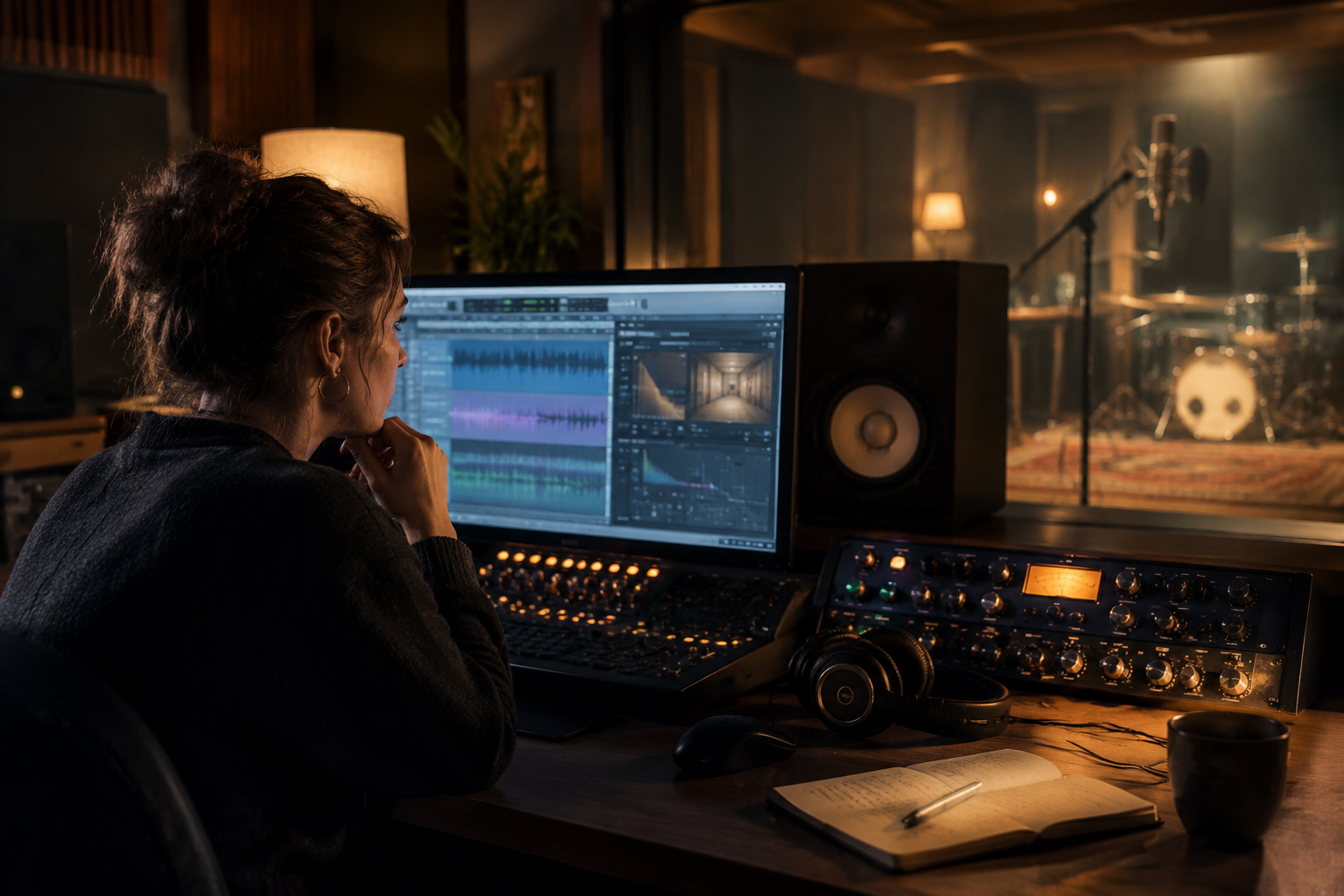
Reverb is the one effect that can make a mix feel finished or drown it in fog. I’ve watched plenty of sessions where the kick and bass are dialed in perfectly, then a hall gets slapped across everything and the low end turns to soup. The plugin isn’t the problem. The choice of reverb type is. A plate, a room, and a hall each do a different job, and using the wrong one is usually what creates mud.
So here’s how the major reverb types actually behave, and how to use each one without burying your mix.
The two families: algorithmic and convolution
Every reverb plugin you load falls into one of two camps.
Algorithmic reverbs generate the tail with math. Cascaded delay lines and filters create the illusion of reflections. This is how the earliest electronic reverb devices worked, which means a lot of the classic reverb sounds we associate with studio records were born this way. They’re not always realistic, but they have character that convolution often can’t match.
Convolution reverbs take a different route. They load an impulse response (IR), a recording of how a real space or piece of hardware responds to a sound, and use it to recreate that space. The result can sound very realistic because it’s based on something that actually happened in a room. The tradeoff is you’re locked to the character of that IR, at least until a plugin like LiquidSonics Reverberate 3 applies Fusion IR processing that lets you modulate and EQ the convolution response like an algorithmic reverb.
Nearly every reverb plugin you’d buy is one of these two, or a hybrid. The type of space it emulates matters more for your mix than which engine is under the hood.
Rooms: the glue
A room reverb emulates a studio room, the kind of space that was built to have a particular sound. That’s the whole point. A room’s job is to put most or all of your mix into a shared space so it sounds like the elements played together. Think of it as sonic glue.
Valhalla Room is the clean standard here, and it’s a good example of what a room reverb should do. The Early section controls the initial reflection pattern and the Late section shapes the decay tail, with frequency-dependent decay so you can darken or brighten the reverb independently of the dry signal. That early reflection control is what places a source in a mix without washing it out, which is the whole trick. Room modes work well on snares and drum buses. Hall modes work when something needs to sit back.
Where rooms go wrong: too much level, too little early reflection control. A wash of room reverb across a whole drum bus is a fast route to a cloudy mix. Use it to place things, not to bathe them.
Plates: bright, smooth, front-of-mix
Plate reverbs came from a physical device: the audio signal ran through a metallic plate, and the plate’s vibrations were recorded. The timbre depended heavily on the plate material, but what we know as the plate sound is bright and smooth. Because of that brightness, plates sit at the front of a mix rather than pushing a source back. That’s why plates work so well on vocals and snares. The classic EMT 140 tube plate is the reference point, and UAD’s emulation of it is genuinely close to the hardware.
ValhallaPlate is an inexpensive way into the sound. If you want a free taste, TAL Reverb 2 is modelled on a plate and goes from natural to lush ambient textures. Arturia’s Rev PLATE-140 is another strong EMT 140 recreation. Soundtoys Little Plate takes the simpler-is-better approach if you just want a lush plate without menu diving.
One thing plates do that matters for mud: they don’t overpower the dry signal. That’s why they blend so easily. When a vocal or snare needs space but still needs to be present, a plate is usually the right call and a hall usually isn’t.
Halls: big, smooth, and easy to overdo
Hall reverbs emulate large spaces: concert halls, cathedrals, big rooms. They sound spacious and flowing, and they push a source further back in a mix. The catch is that same quality makes them the most dangerous reverb for a busy arrangement. If everything gets a hall, everything moves back, and suddenly nothing has a defined position.
Halls work on instruments that genuinely need to sit back: pads, strings, atmospheric elements, maybe a vocal on a sparse track. On a dense pop mix, a hall on the lead vocal will fight every other element competing for that same back-of-the-stage real estate.
Chambers and springs: the character options
Chambers were the studio engineer’s workaround for not having a cathedral. A small side-room with angled, reflective surfaces. Audio was played into it through a speaker, captured with mics, and mixed back in as a wet signal. That process makes chambers feel denser and thicker than other reverbs, because they really are a small space forced into extra reflections.
Spring reverbs came from the same physical-reverb family, just with a spring instead of a plate. The sound lands somewhere between close echoes and smooth reflections, and it’s a staple of classic rock guitar tone. If you’re chasing that specific guitar sound, you want a spring, not a hall.
The mud problem is a frequency problem
Here’s the honest reason most reverb sounds muddy: low-frequency buildup. Reverb adds energy everywhere, including under 200 Hz where your kick and bass already live. Every reverb tail adds more low-end information that wasn’t there before, and the result is a mix that feels woolly and undefined.
This is where reverb plugins with built-in EQ earn their price. FabFilter Pro-R uses a spectral display to show where the reverb energy sits across the spectrum, and you can EQ directly from that display. The six-band EQ lets you carve mud below 200 Hz, tame harshness around 3 kHz, and add air above 10 kHz without leaving the plugin. That makes it the right tool when reverb needs to sit in a busy mix without fighting other elements. On vocals, darkening the reverb below 500 Hz keeps the vocal present. On drums, it stops the low end from piling up in the tail.
What Pro-R doesn’t do is character. It’s clean and surgical. If you want the sound of a specific vintage plate or hardware unit, a character-first plugin gets you there faster. And Pro-R doesn’t match the convolution accuracy of a dedicated IR reverb for real-space emulation.
If you don’t have a surgical reverb, the fix is simple: put an EQ after your reverb and high-pass it. Cut everything below 200 to 300 Hz. It’s not as elegant as doing it inside the plugin, but it solves the exact same problem.
Picking by task, not by brand
The practical decision tree looks like this.
- Need cohesion across a whole mix? A clean room reverb, applied lightly, shared across elements.
- Vocal or snare that needs space but must stay upfront? A plate.
- Something that should sit back in the mix? A hall, used on that element alone.
- Guitar with classic rock character? A spring.
- Real-space realism, post-production dialogue, classical? Convolution or a clean algorithmic room. Vintage color is the wrong tool here.
VintageVerb is character-first and accuracy-second, which makes it great for 70s and 80s plate and hall sounds and wrong for a transparent dialogue room. Valhalla Room is the opposite: clean and realistic. The brand matters less than matching the reverb type to what the source needs to do.
One more practical note: a single reverb that covers most scenarios, like Valhalla Room, is often enough for a small studio. Buying a whole suite before you understand which type you actually reach for is backwards.
Fast workflow to avoid mud
Reach for placement before level. Decide where the source should sit, then pick the reverb type that achieves it. Plate for upfront, hall for pushed back, room for shared space.
High-pass the reverb return every time. Below 200 to 300 Hz is almost never useful reverb information.
Shorten the decay before you lower the level. A long tail at low volume is still a long tail, and it’s still eating your clarity. If the reverb feels wrong, the decay time is a better first adjustment than the mix knob.
Use different reverb types across a mix instead of one across everything. A plate on the vocal and a room on drums places both in a real, distinct space. The same hall on both flattens them into the same fog.
That’s the whole discipline. Reverb isn’t complicated. It’s just easy to use the wrong type and then blame the plugin for the mud.