The Best Budget Audio Interfaces for Home Studios in 2026
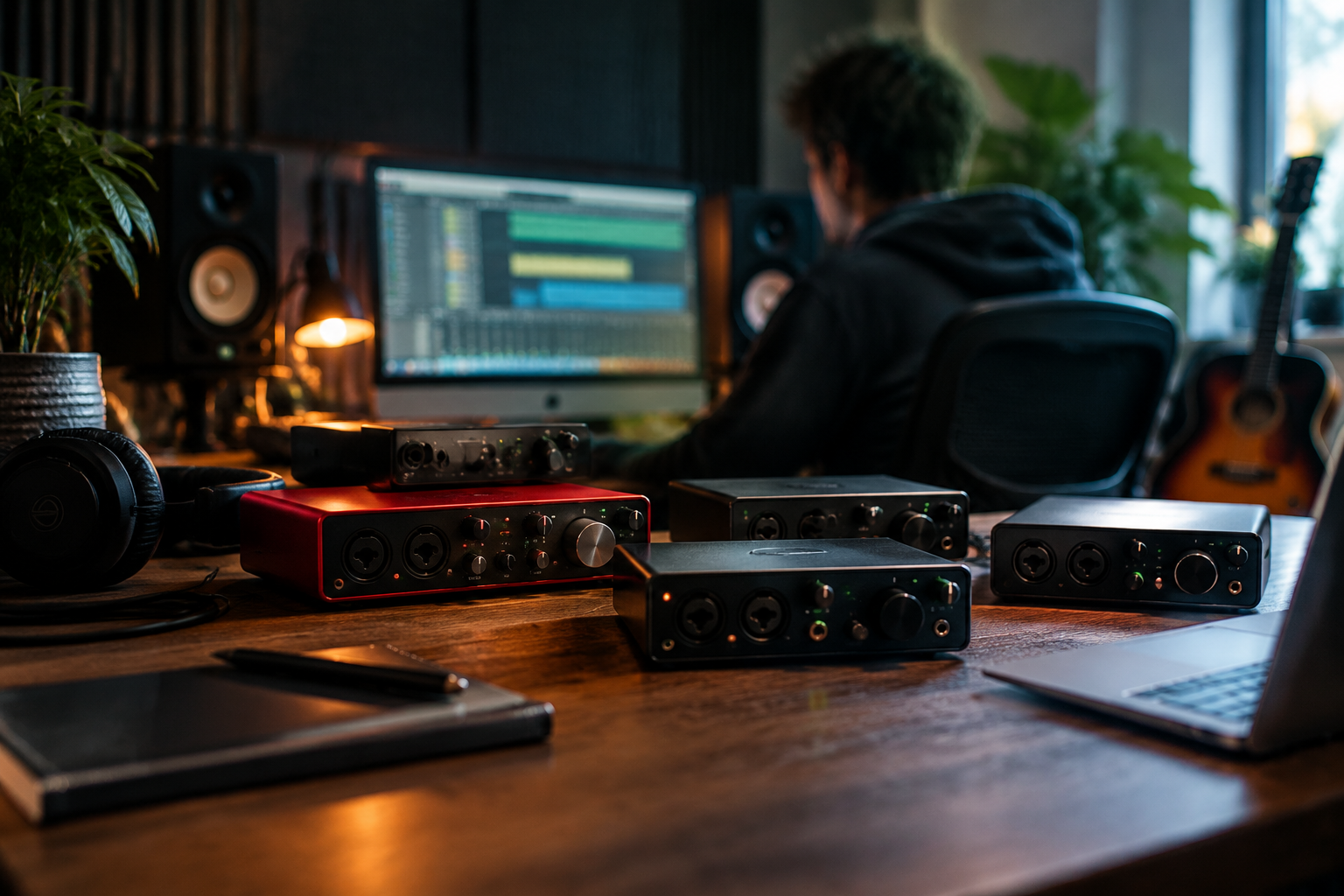
Everyone wants to argue about preamps. Here’s the thing: at the budget end, your room and your mic matter more than the converter chip inside a $130 box. What actually makes or breaks a cheap interface is gain headroom, how easy the thing is to set up, and whether the drivers stay stable at 64 samples with twelve tracks running. That’s the stuff I care about.
So I went through what’s actually worth buying in 2026 and sorted it by what you’re recording, not by price alone. Most of these I’ve either used or know well enough from other producers to give you a straight answer.
The one most people should buy
Focusrite Scarlett 2i2 4th Gen (~$190). Yes, it’s the obvious pick. It’s the obvious pick because it’s the best two-input interface for most home setups, and the 4th Gen finally fixed the weak spot that bugged me about earlier versions.
The preamps now deliver up to 69dB of gain. That number matters. Older budget interfaces struggled to push a dynamic mic like an SM7B to a usable level without an inline preamp. Sixty-nine decibels gets you there cleanly. Both instrument inputs are on the front panel, which sounds trivial until you’re unplugging your guitar for the tenth time to get to the back.
Two other things earn their keep. Auto Gain sets your input level automatically. Clip Safe rides the gain in real time if a take spikes, so you don’t lose the one good vocal performance to one bad note. And Air mode adds a gentle high-frequency lift borrowed from Focusrite’s ISA preamps. On acoustic guitar and vocals, I leave it on most of the time.
Converters are rated at 120dB dynamic range, 24-bit/192kHz, USB-C, bus-powered. That’s more spec than anyone cutting demos in a bedroom needs, but it means the thing won’t be the weak link when you upgrade your mic.
What I don’t love
It’s still a two-input box. The moment you want to track a drum kit or mic a full band, you’re out. There’s also no MIDI I/O on the 2i2, which is a real annoyance if you’re using 5-pin gear alongside USB controllers. Plan around that.
The budget picks, if $190 is already too much
Focusrite Scarlett Solo 4th Gen (~$130)
Same preamp upgrade as the 2i2. One mic input, one Hi-Z instrument input, USB-C, 24-bit/192kHz. If you’re a solo guitarist or vocalist recording one source at a time, this is the correct purchase and you can put the $60 toward a better mic. The Solo is the best-selling interface in the world for a boring reason: it does the job and it’s cheap. The limitation is baked into the name. One input at a time.
Audient EVO 4 (~$130)
This is my pick if you’re genuinely new to recording and gain staging is the thing tripping you up. Smartgain listens to your signal and sets the level for you. It sounds like a gimmick until you’ve spent a session chasing a vocal that clips every chorus.
The preamps are the real story. Audient borrowed the design from their higher-end consoles, and they hit 58dB of gain with a clean, transparent character. On a budget interface that’s genuinely unusual. Where it falls short is features and feel: the form factor is compact to the point of feeling sparse, and 58dB won’t drive a low-output dynamic as comfortably as the Scarlett’s 69dB. If your main mic is a condenser, ignore that. If you live on an SM7B, it matters.
The jump to $200 to $500, and when it’s worth it
This tier is where the real value sits. Better preamps, better converters, better build. If you can stretch, stretch.
SSL 2+ MkII (~$350)
Solid State Logic put their console preamp sound in a desktop box, and it holds up. The preamps are clean and detailed. The Legacy 4K mode adds the harmonic color SSL consoles are known for, and on drums and electric guitar it’s not subtle in a bad way. It gives you a bit of that recorded-through-a-console character without any rack gear.
What separates the 2+ from most two-input interfaces is the output count. Four outputs, two beyond the standard monitor pair, means you can run a separate headphone mix or route a send to external effects. That flexibility is rare below $400. If you’re mixing in the box and only ever need two outs, you’re paying for something you won’t use. If you’re tracking other people, you will.
Mackie Onyx Artist 1.2
A compact, no-frills option built around Mackie’s Onyx preamp. One mic input, rugged enclosure, dead simple controls. Good for solo artists and podcasters who want a clean front end and nothing else. Two honest drawbacks: no MIDI, and only one preamp, so you can’t track two mics at once. Fine for a solo workflow, limiting for anything else.
PreSonus AudioBox USB 96
Worth a mention for mobile recording. Easy setup, portable, and it’ll get you started without a fight. It’s not going to win any preamp shootouts against the SSL, but it’s dependable and the price reflects that.
How to actually choose
Work backwards from your recording situation, not from specs.
- Inputs: One or two covers most solo producers and singer-songwriters. Four or more is the moment you’re tracking drums or a live band.
- Outputs: Two for monitors is the floor. Extra outputs mean separate headphone mixes or external effects routing.
- Connectivity: Match your computer’s ports. USB-C is standard now, but check before you buy.
- MIDI: If you use 5-pin MIDI gear, confirm the interface has MIDI in and out. Many budget units skip it entirely.
- Latency and drivers: Read about stability under load, not the marketing number. A stable driver at 128 samples beats a flaky one at 32.
- Gain: If you run dynamic mics, look for high gain specs. 69dB (Scarlett 4th Gen) or 58dB (Audient) tells you which is easier with a hungry mic.
One more note on front-panel instrument inputs. It’s a small thing, but front-panel access means you’ll actually plug in and record instead of leaving the cable coiled on the floor. Check where the Hi-Z input sits before you commit.
My verdict
Buy the Scarlett 2i2 4th Gen unless you have a specific reason not to. It has the gain for hard-to-drive mics, the instrument inputs where you want them, and features that save takes rather than decorate the spec sheet. If money is tight, the Solo at $130 records the same quality across one input. If you’re new and gain staging is your wall, the EVO 4 sets your levels for you at the same price.
And if you’ve got $350 and you want preamps with real character plus room to grow, the SSL 2+ MkII is the one I’d save for. The difference between $130 and $350 isn’t night and day, but it’s audible, and it’s the tier where a home studio stops sounding like a home studio.